
Verksamhetskoll Bankruptcy analysis · For bankruptcy administrators
Recovery, insolvency and bookkeeping deficiencies. From the SIE file, traceable to the journal entry.
Upload the debtor's SIE files (SIE 4, the Swedish standard format for exporting accounting data). In minutes the AI has done the complete bankruptcy analysis: recovery, insolvency, control balance sheet and bookkeeping deficiencies, every item traceable to the journal entry.Upload the debtor's SIE files (SIE 4, the Swedish standard format for exporting accounting data). In minutes the AI has done the complete bankruptcy analysis: payments to test for recovery (clawback), signs of insolvency with a period to investigate further, the control balance sheet date and observations on the bookkeeping. Every item with date, counterparty, amount and journal entry, grounded in the relevant legal provisions. The same analysis is used in company restructuring.
From SIE file to material for the administrator
Upload the debtor's SIE files
Every financial year there is. Business unit, cost unit and project come along, as do all the company's other dimensions. No mapping and no access to the debtor's system is needed.
The analysis runs in Sweden
Storage and AI processing take place in Sweden, in Microsoft Azure Sweden Central. The engine calculates, the AI adviser answers. Every journal entry, every period, every counterparty is gone through.
Structured report in minutes
Nine sections with the same structure in every case. Every item can be traced down to the journal entry.
What you get
The core questions of the investigation. Answered, reasoned, traceable.
The same questions are asked in every case. Verksamhetskoll answers them directly from the debtor's books, with reasoning that stands up to scrutiny.
The insolvency and the period to investigate
Capital deficiency, build-up of debt, credit periods and cash are followed month by month from the books. The report distinguishes over-indebtedness from inability to pay and suggests a period to investigate further where the payment signals cluster, with the figures each observation rests on. The material for your assessment of the date of insolvency, which decides both recovery questions and the personal liability of the company's representatives.
The control balance sheet date
The system reads the registered share capital directly from the books and points out the month in which the adjusted equity first fell below half of it: the bookkeeping-based indication that the duty to prepare a control balance sheet may have arisen. Each period of capital deficiency is assessed on its own, by whether it remained at the year-end closing. Month by month, without manual reconstruction.
The recovery window
The outgoing payments in the three months before the cut-off date (fristdagen, the day the bankruptcy petition was received by the court), with counterparty, amount and journal entry reference. The system separates actual payments from booked invoices, so the list shows what actually left the company. Payments after the bankruptcy decision are reported separately, as questions of the debtor's power of disposal under chapter 3 of the Bankruptcy Act and not as recovery.
Bookkeeping deficiencies and review actions
Gaps in the journal entry numbers per series and year, periods without bookkeeping, the last day of bookkeeping against the bankruptcy decision, opening balances that do not match the previous year's closing balances, and financial years that were never closed. Compiled as observations, each with recommended review actions for the continued investigation.
The observations are material for your assessment. The system flags, explains and gives references, and the conclusion is always the administrator's.
Structured report in nine sections
The same structure in every case, and every item traceable down to the journal entry. The analysis follows the points of the administrator's report under chapter 7, section 15 of the Bankruptcy Act, and the report itself states where the line is drawn: the system identifies and explains the points to examine, the administrator makes the legal assessment.
The PDF is created directly in the browser, with your own logo. If you ask follow-up questions, the whole dialogue is included in the PDF.
- 01Summary
- 02Company details and control balance sheet screening
- 03Health index and Altman trend
- 04Insolvency indicators and period for further investigation
- 05Suspicious/large transactions
- 06Related parties and transfers of value
- 07Payments for review
- 08Bookkeeping deficiencies
- 09Recommended review actions
The real product
Ask. Get answers with source references.
Screenshots straight from the tool, fictitious bankrupt company: ask the investigation question in plain language and get the answer with the exact month, account and amount. Material that stands up to scrutiny.
The control balance sheet question, answered with the exact month
The question "When did the duty to prepare a control balance sheet arise?" answered with the exact month, share capital from account 2081 and adjusted equity at that point.
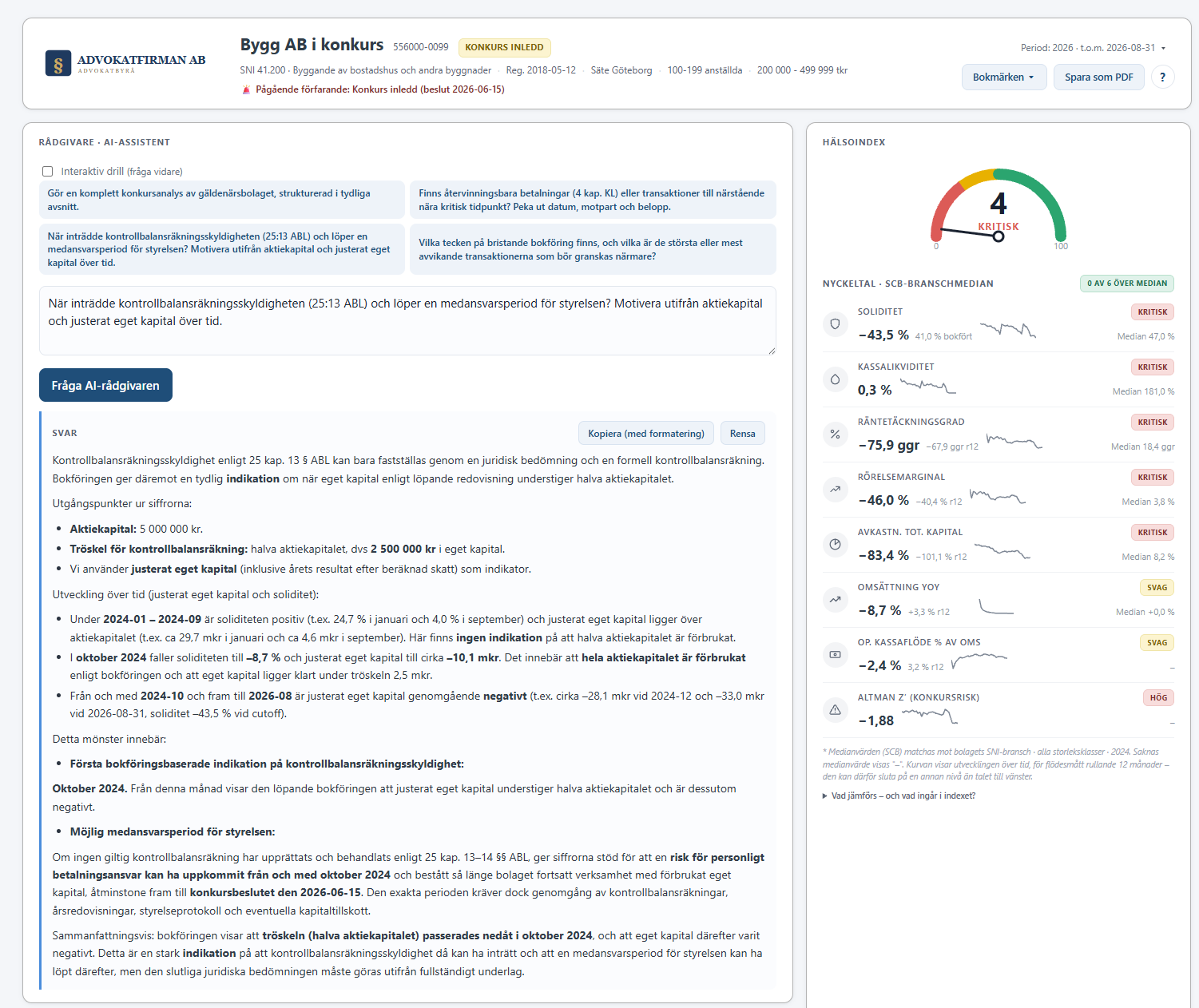
The AI answer separates the indication in the books from the legal assessment and states what remains to be examined. Click the image to enlarge.
The signs of insolvency, step by step
From the complete bankruptcy analysis: the tool separates over-indebtedness from inability to pay in practice, follows the development month by month and points out the build-up of debt and selective repayment with date, counterparty and amount.
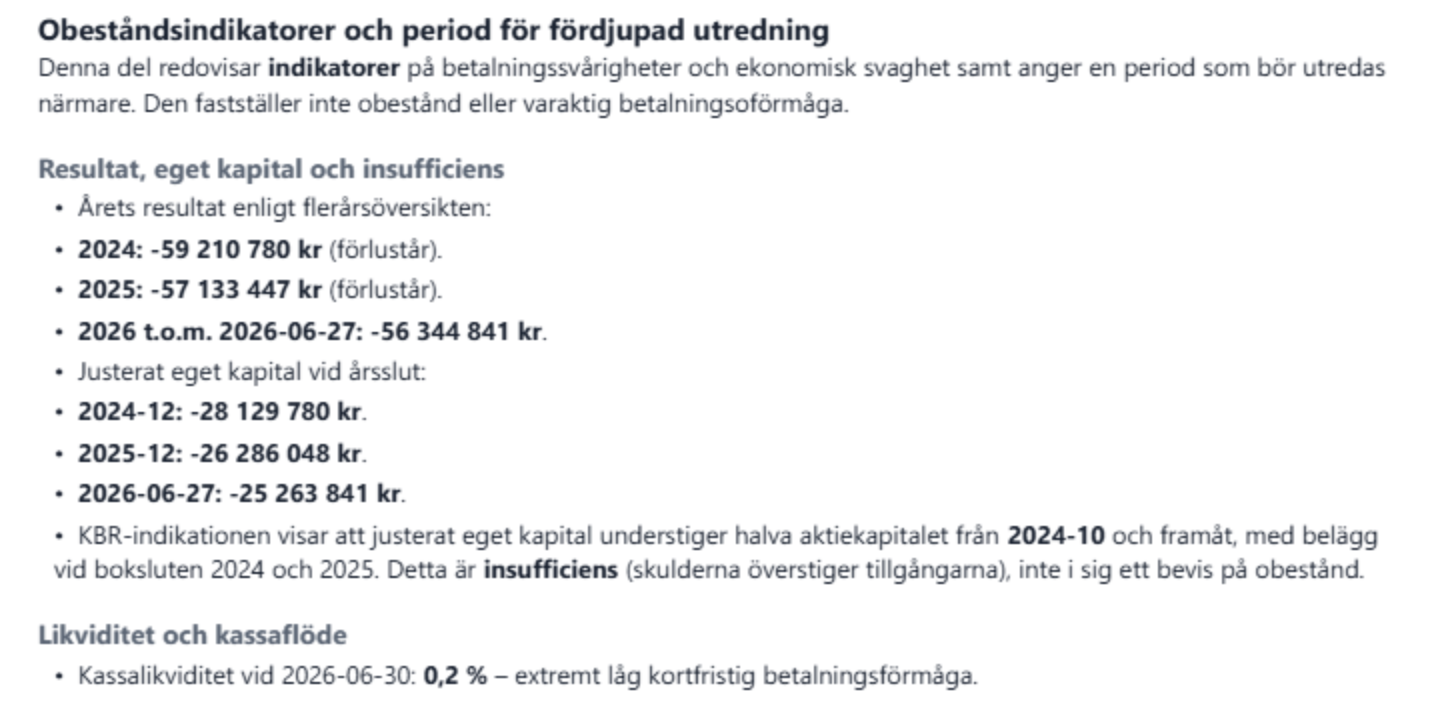
Free text against the books
The questions you already ask.
Ready-made standard questions come with the mode. The rest you write to the AI adviser just as you would say them, with follow-up questions on every answer. The answers come with date, counterparty, amount and journal entry.
"Show payments to owners, the board or related companies"
"Which suppliers were paid shortly before the bankruptcy?"
"Are there payments that deviate from the historical pattern?"
"Show unusual transactions in the last twelve months"
"Are there gaps in the bookkeeping or periods without bookkeeping?"
"Show the largest transactions in the last three months"
Six examples. The four ready-made standard questions cover the complete bankruptcy analysis, recovery, control balance sheet and bookkeeping deficiencies.
Getting the material in
Request the books where they are.
You are entitled to the debtor's accounting records. The problem is rarely the right but the way there: the material sits with an accounting firm or a company representative who does not know what an SIE 4 file is, or who sends a printout.
Send a file request
Enter the email address of whoever keeps the books. The request says exactly what is needed: SIE 4 with transactions, every financial year there is, and how to export the file from the common accounting systems.
They hand over the files
The invitation goes to the same address, and if the address has no Microsoft account, the recipient signs in with a one-time code. No account to create and nothing emailed back and forth. They see a single box and never your case.
You see what is missing
The analysis starts when you say so. Periods without bookkeeping and year ends without closing are reported as deficiencies with suggested review actions, instead of silently dropping out.
What can still be investigated when the material is incomplete is covered in the guide on incomplete bookkeeping (in Swedish).
The state of the industry
Reading an SIE file is nothing new. Investigating it in minutes is.
The SIE file is the new standard
The Swedish industry organisation REKON is pushing for the debtor's books to be preserved digitally as an SIE file in bankruptcy. That is exactly the file Verksamhetskoll reads, without conversion and without special orders.
The review is still manual
The date of insolvency, recovery candidates and bookkeeping deficiencies are today largely investigated in spreadsheets, or bought as investigation hours. Time that rarely fits in small and medium-sized bankruptcies.
The authorities point out the need
The Swedish Economic Crime Authority (Ekobrottsmyndigheten) has called for digital risk indicators and automatic searchability in bankruptcy investigations. That is exactly what a structured, traceable analysis of the debtor's books provides.
The AI never establishes criminal conduct. The system flags for review and explains why, with traceable material down to the journal entry. Every answer is tested against a quality check before it is shown: an answer that states something legal in definitive form and cannot be corrected is not shown at all. The assessment is always yours.
The comparison run
Bring a closed case. Compare with the answer key.
A case you have already investigated is the most honest test: you know the answers and can see whether the tool finds them. Free of charge and with no strings attached.
Confidentiality first
We give you a confidentiality undertaking before any case is uploaded, signed digitally with BankID, the Swedish e-ID.
You upload it yourselves
You get a login and drag in the debtor's SIE files yourselves, every financial year there is. Nothing is emailed, nothing is sent to us.
Walkthrough within two working days
The bankruptcy analysis is ready in minutes. Within two working days we go through it together, in about 45 minutes.
You compare with your investigation
The signs of insolvency, recovery candidates, the control balance sheet date and bookkeeping deficiencies against what you found yourselves. The run is free of charge. Afterwards you keep the account or delete the estate.
Price
Pay for the number of estates. Not for which ones.
Estates are added as they come in and removed when the investigation is done. You pay for how many are active at the same time, not for how many have passed through.
Bankruptcy analysis
Three estates included.
+ SEK 890 per month per additional user
Everyone on the account shares the same companies, with no double charging.
+ SEK 200 per month per extra estate
The slots are not locked to named estates. Switch in a few seconds.
Everything included
- The complete due diligence report or bankruptcy analysis from an SIE file in minutes, with no integration and no mapping
- Health index and key ratios against the Statistics Sweden (SCB) median for the same industry and size
- AI analysis grounded in the company's own figures, down to journal entry level
- Advanced report builder with drill-down and Excel export
- PDF reports with your own logo, created directly in the browser
- Several companies in one combined group view
- Storage and AI processing in Sweden (Microsoft Azure Sweden Central)
Terms
- When the case is finished, you remove the company and the slot is free for the next one
- Contributors who only submit files cost nothing
- The first run is free of charge, on a case where you already know the answer
- Volume pricing from six users
- No set-up fees
- All prices excl. VAT
Guides
The method behind the answers.
What the law requires and where in the books the material is found, step by step.
Frequently asked questions
Before you book.
- What do we need to run an analysis?
- The debtor's SIE 4 files with transactions, preferably every financial year there is. Drag and drop them into the tool. No mapping or preparation is needed, whichever accounting system the file was exported from. A balance file (SIE 1 to 3) is not enough for transaction analysis, and the tool says so when the file is loaded.
- What if the debtor's bookkeeping is incomplete?
- The analysis is based on what is in the SIE files and does not invent missing information. Periods without bookkeeping show as empty months in the series and year ends without closing as jumps in equity, and such observations are reported as bookkeeping deficiencies with suggested review actions. The report states which financial years and which date the material covers. The guide on incomplete bookkeeping (in Swedish) goes through what can still be investigated.
- Do you handle the estate's ongoing accounting too?
- No. Once the bankruptcy decision has been made, a new set of books is opened for the estate on a bankruptcy chart of accounts, where the priority of claims already follows from the chart of accounts, and it is kept in your own accounting system. Verksamhetskoll Bankruptcy analysis is the investigation of the debtor's books up to the day of bankruptcy: date of insolvency, recovery, control balance sheet and bookkeeping deficiencies, in other words the material for the administrator's report.
- Do we have to connect any system?
- No, and you could not count on it anyway. The debtor's books are loaded as an SIE 4 file, the format in which they leave the bankrupt company whichever accounting system they were kept in. No integration, no access to the debtor's system and no mapping of the chart of accounts. You drag in the files and the analysis begins.
- Where is the data handled?
- Storage and AI processing of the financial data take place in Sweden, in Microsoft Azure Sweden Central, and every customer has its own separate database. The PDF reports are also created locally in the browser. The page on confidentiality and data handling (in Swedish) describes the whole chain, from the confidentiality undertaking to the deletion of estates.
- Who is behind Verksamhetskoll?
- Cenrotech AB, a Swedish product company with twenty years of experience in decision support. Verksamhetskoll is used by everything from owner-managed companies to groups and municipally owned organisations, and all development, operations and support take place in Sweden. The company presents itself at cenrotech.se (in Swedish).
- What does it cost?
- SEK 1,490 per month for the first user, excl. VAT, and three estates are included. Each additional user costs SEK 890 per month, and estates beyond the three cost SEK 200 per month per estate. The slots are not locked to named estates: when the investigation is done you delete the estate and the slot is free for the next one, so you pay for how many cases are active at the same time and not for how many have passed through. Contributors who only submit files cost nothing, and there are no set-up fees. The price includes the bankruptcy analysis: the transaction review for recovery, the review of insolvency and control balance sheet, and the structure of the administrator's report.
- How do we get started?
- Book a comparison run on a closed case: you upload the files yourselves after a signed confidentiality undertaking, we go through the analysis together within two working days, and you compare with your own investigation. That run is free of charge. If it holds up, you set up the account and bring in the next estate straight away, with no set-up fee.
Does your firm keep the estates' books in Hogia OpenBusiness? The overview of all estates, the half-year reports, the final account and the bank reconciliation are in Extended report package for bankruptcy administrators (in Swedish), built together with Hogia.
Compare with your own investigation.
Book a comparison run: you upload a closed case, we go through the analysis together within two working days, and you compare with the answer key. It is the most honest test we can offer.
Two modes, the same engine and price
In the wrong place? Switch track. The same analysis engine, before the deal and after the crash.
Both are modes in Verksamhetskoll Company analysis.