
What is group consolidation?
A group is legally several companies but economically one unit. The consolidation is the translation between the two. If the companies' figures are simply added together, the picture is wrong in a systematic way: if a subsidiary sells for three million to a sister company, the three million count both as revenue in one and as a cost in the other, even though the group as a whole has not earned a krona on the deal.
The same double counting exists in the balance sheet. A receivable in one company is the same krona as another company's payable, and the parent's shares in the subsidiary are the same capital as the subsidiary's own equity. The consolidation removes the double counting so that the group's revenue, total assets and key ratios become comparable with those of a single company.
What should be eliminated, and why?
Swipe sideways to see the whole table
| Item | Why it is removed | Effect |
|---|---|---|
| Intra-group receivables and payables | One company's receivable from a sister company is the same krona as the sister company's payable. | Total assets go down, profit is untouched. |
| Intra-group sales and purchases | The group becomes neither more nor less profitable because its companies trade with each other. | Revenue goes down, operating profit is unchanged. |
| Shares in subsidiaries | Without elimination the same capital appears twice: as shares in the parent and as equity in the subsidiary. | Both assets and equity go down. |
| Dividends from subsidiaries | A dividend within the group is not income, only a movement of capital within it. | Profit is cleaned of intra-group dividends. |
That check is worth remembering. When as much is removed from sales as from purchases, operating profit should be the same before and after. If profit moves, the elimination has removed more on one side than on the other, and then it is the underlying data that should be reviewed.
How the consolidation works
- 1
The companies are read in
Each company is fetched from its own accounting system, or read in as a SIE file. The systems can differ between the companies and the financial years can be broken, because each company is consolidated against its own booked position. SIE 4 is the Swedish standard format for exporting accounting data.
- 2
The counterparties are normalised
Customer and supplier names are cleaned with AI as soon as they are read in, so that the same counterparty is recognised even when the companies write the name differently. That is what makes it possible to find intra-group trade automatically.
- 3
Account names are aligned, if they differ
If the companies have spelled the same account differently, you decide what the account should be called across the group, and the AI can suggest the names. If the companies use the account for different things, that is flagged instead, so that a common label does not hide the difference.
- 4
The companies are selected
In the company picker you tick the companies that should be included. The view recalculates and shows the group as a straight sum.
- 5
The elimination is switched on
With the checkbox for intra-group items, the engine matches intra-group balances on account number, account description and counterparty name, and eliminates them. The matching is deterministic, so the same data always gives the same result.
- 6
The reconciliation is read
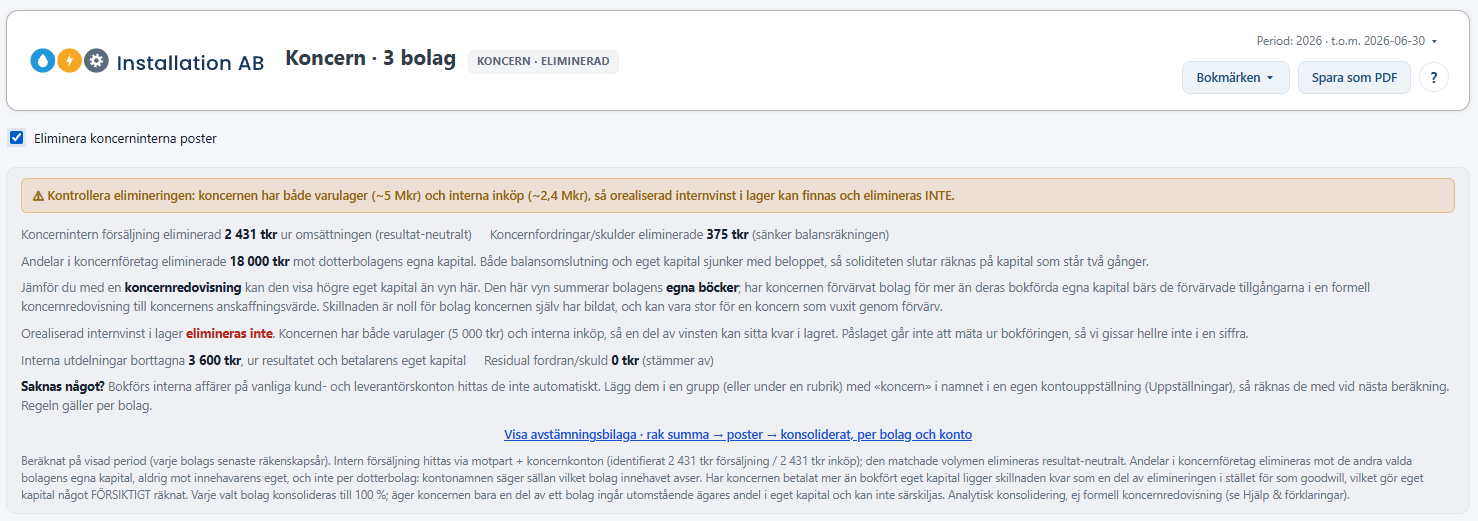
The panel shows what was removed, item by item and account by account, with an appendix that goes from the straight sum via the items to the consolidated outcome, per company and account.
There is no setup project before the first result: no group chart of accounts to build, no mapping table to maintain per company. The consolidation is a view, not a monthly process, which is the difference between seeing the group every day and seeing it after each year-end close.
Try it yourself
The group view in the demo
The demo opens Planning with three fictitious companies. Open the company picker, choose several companies and select all, and the view becomes a group. Then tick the elimination and open the reconciliation: intra-group sales, group receivables and the shares in the subsidiaries are written out with amounts.
Try it yourselfThe reconciliation: straight sum to consolidated
What separates a consolidation you can trust from a black box is whether it can be followed. The reconciliation puts three columns side by side for each item: straight sum, elimination and consolidated.
- Total assets, equity, operating income and operating profit, each with its elimination effect.
- The offsetting entry lines behind each item, with company and net effect.
- Accounts affected, sorted by size, with account number, description, type and amount.
- Items that did not net out: when group receivables and payables do not total the same, the lower amount is eliminated and the difference is left untouched and reported separately.
- An appendix that goes from the straight sum via the items to consolidated, per company and account.
Differences are a useful result in themselves. They point out intra-group balances where two companies have booked differently, and that reconciliation is best done continuously instead of in year-end week.
What the tool cannot see
The calculation is based on the companies' own books. Formal consolidated accounts contain items that are never there, and the tool does not claim otherwise. Three limits apply:
- Group surplus values and goodwill. Where the group has acquired companies, their assets are carried in the consolidated accounts at the group's acquisition cost, not at the subsidiary's book value. The difference is zero for companies the group formed itself and can be very large for a group that has grown by acquisition.
- Unrealised profit in inventory and fixed assets. The tool flags it when it looks to be present, but cannot calculate the amount without knowing which goods were bought internally.
- Non-controlling interests. The subsidiaries are added up at a hundred per cent regardless of the ownership share.
The wording above is the tool's own. It stands in the elimination view under the heading about what the calculation cannot see, next to the figures it applies to, instead of in a terms document.
How you control what counts as intra-group
The automatic matching finds intra-group trade that has been booked on group accounts or against a recognised group counterparty. If internal deals are instead booked on ordinary customer and supplier accounts, they are not shown automatically, and you need to tell the tool which accounts are internal.
That is done in your own statement layouts: put the accounts in a group, or under a heading, with the word "koncern" (Swedish for group) in the name, and they are included in the next calculation. The rule applies per company, so an account that is intra-group in one company and external in another is controlled with row placement for that company. The layouts are described in more detail on the page about financial reporting.
How you do it in Verksamhetskoll
The group view is a mode in Verksamhetskoll Planning for organisations, not a separate module. The same reports, the same key ratios and the same AI adviser work on the group as on a single company: free text or a suggested question, and follow-up questions in the same dialogue.
- Tick the companies and the group is consolidated. No group chart of accounts to build first, and the systems and financial years can differ between the companies.
- Elimination of intra-group receivables and payables, intra-group sales, shares in subsidiaries and intra-group dividends, with deterministic matching.
- Reconciliation line by line, with the accounts affected and an appendix from straight sum to consolidated, and the limits goodwill, unrealised intra-group profit and non-controlling interests written out in the view.
- Common account names across the group when the companies have spelled the same account differently, with suggestions from the AI.
- Budget for several companies in one go, and a liquidity forecast where the companies' curves are summed and internal payments cancel each other out.
- The AI adviser answers on the group in straight-sum and eliminated mode, and you take the answer further with follow-up questions in the same dialogue.
Storage and AI processing in Microsoft Azure Sweden Central. The price for more companies is stated openly on the pricing page.
Common questions
Questions that often come up.
- What does group consolidation mean?
- Group consolidation means that the companies' figures are added together into a single picture of the group, and that what the companies have done with each other is removed. Without the elimination, intra-group sales, intra-group receivables and payables and the parent's shares in the subsidiaries are counted twice, and the group looks larger than it is.
- What is eliminated in a consolidation?
- Four items always recur: receivables and payables between the group companies, sales and purchases between them, the parent's shares in the subsidiaries against the subsidiaries' own equity, and dividends from subsidiaries to the parent. Operating profit should be unchanged after the elimination of intra-group trade, because as much is removed from sales as from purchases.
- Does this replace the consolidated accounts at year end?
- No. This is an analytical consolidation built for ongoing follow-up, not formal consolidated accounts. The calculation is based on the companies' own books and therefore does not include group surplus values and goodwill from acquisitions, estimated unrealised profit in inventory, or non-controlling interests. The view can therefore differ from a published set of consolidated accounts without either being wrong, because they measure different things.
- Does it work if the companies have different accounting systems?
- Yes. Each company is consolidated against its own booked position, so the systems can differ and the financial years can be broken. The books are fetched through a connection to Hogia, Fortnox or Spiris, or read in as a SIE file. The group view is included in Planning for organisations.
- How is intra-group trade found when the companies write the counterparty names differently?
- Customer and supplier names are normalised with AI as soon as they are read in, so that the same counterparty is recognised even when the companies spell or abbreviate it differently. The matching and the elimination themselves are then done by the engine on account number, account description and counterparty name, which means the same data always gives the same result.
- What happens if two companies disagree about an intra-group balance?
- Then the lower of the amounts is eliminated, and the difference is left untouched and reported separately. A difference means that one company has booked a receivable that the other has not booked as a payable, or the other way round. It is not an error in the calculation but in the underlying data, and worth reconciling between the companies before the year-end close.
Further reading