
Verksamhetskoll Due Diligence · Financial due diligence from the SIE file
Normalised earnings, net debt and dependencies. From the SIE file, traceable to the journal entry.
Upload the target company's SIE files. In minutes the AI has done the whole review for acquirers and their advisers: normalised earnings, net debt, dependencies and what is left to verify.Upload the target company's SIE files, one per financial year. In minutes the AI has done the whole review for acquirers and their advisers, in nine sections: earnings with the one-off items adjusted, net debt and working capital, dependence on customers and suppliers, cash flow, the sector comparison and what is left to verify in the acquisition.
From SIE file to acquisition material
The target company's SIE files in
One SIE 4 file (the Swedish standard format for exporting accounting data) per financial year, with journal entries. You upload them yourself or send a file request to the seller. No integration and no mapping of the chart of accounts.
The analysis runs in Sweden
Storage and AI processing take place in Sweden, in Microsoft Azure Sweden Central. The engine calculates the figures from the books, and the AI writes on the basis of them.
A review in nine sections
The same structure for every target company, in minutes. Every figure is traceable down to the journal entry, and the PDF carries your own logo.
What you get
The questions a financial due diligence asks. Answered from the books.
The engine calculates the figures from the target company's books, and the AI writes the review on the basis of them. Every item with year, amount and journal entry.
Earnings and normalised earnings
Items affecting comparability per year, with journal entry numbers: capital gains and losses, impairments, insurance compensation, grants and group contributions. Operating profit, EBITDA and adjusted EBITDA year by year, and which level is recurring.
Net debt and working capital
Interest-bearing debt, net debt or net cash and the components of working capital at each year end, plus net debt to EBITDA. The figures the purchase price is adjusted for.
Dependencies
The largest customers and suppliers per year, how much of revenue the named rows cover, and which customers have decreased or disappeared.
Cash flow and liquidity
Operating cash flow and what drives it: trade receivables, taxes and dividends. How cash has moved between the years, and how much of the profit turns into cash.
Sector comparison and health index
Six key ratios against the median from Statistics Sweden (SCB) for the same sector and size class. A health index of 0–100 from seven key ratios against fixed target values, the same scale for every company.
Risks and what needs verifying
Related parties and value transfers, dividends against the room for dividends, tax liabilities and the state of the books, as business risks. Last, what the books cannot show: contracts, security, disputes, pensions and ownership.
The same nine sections for every target company
The sections are always included, in the same order, and a section with no findings says so. The report reads like an investor memo and states itself where the limit goes: the analysis identifies financial signals and questions, and the acquirer makes the final assessment.
The Due Diligence mode deliberately makes no insolvency assessments. Related parties, tax liabilities and the state of the books are described as business risks, not as bankruptcy law. The PDF is created in the browser with your own logo, and follow-up questions come with it.
- 01Summary
- 02Company facts
- 03Earnings and normalised earnings
- 04Dependencies
- 05Working capital and net debt
- 06Cash flow and liquidity
- 07Sector comparison
- 08Risks and warning signs
- 09To verify in the acquisition
The real product
The example report. Page by page.
Installation AB is the fictitious electrical and plumbing company you meet in the open demo: revenue grows by 13 per cent, but the equity ratio is 6.6 per cent and net debt has almost quadrupled in a year and a half. The review adjusts a one-off gain, shows that working capital ties up more and more, and points out dividends and management fees that should be handled in the purchase price and terms.
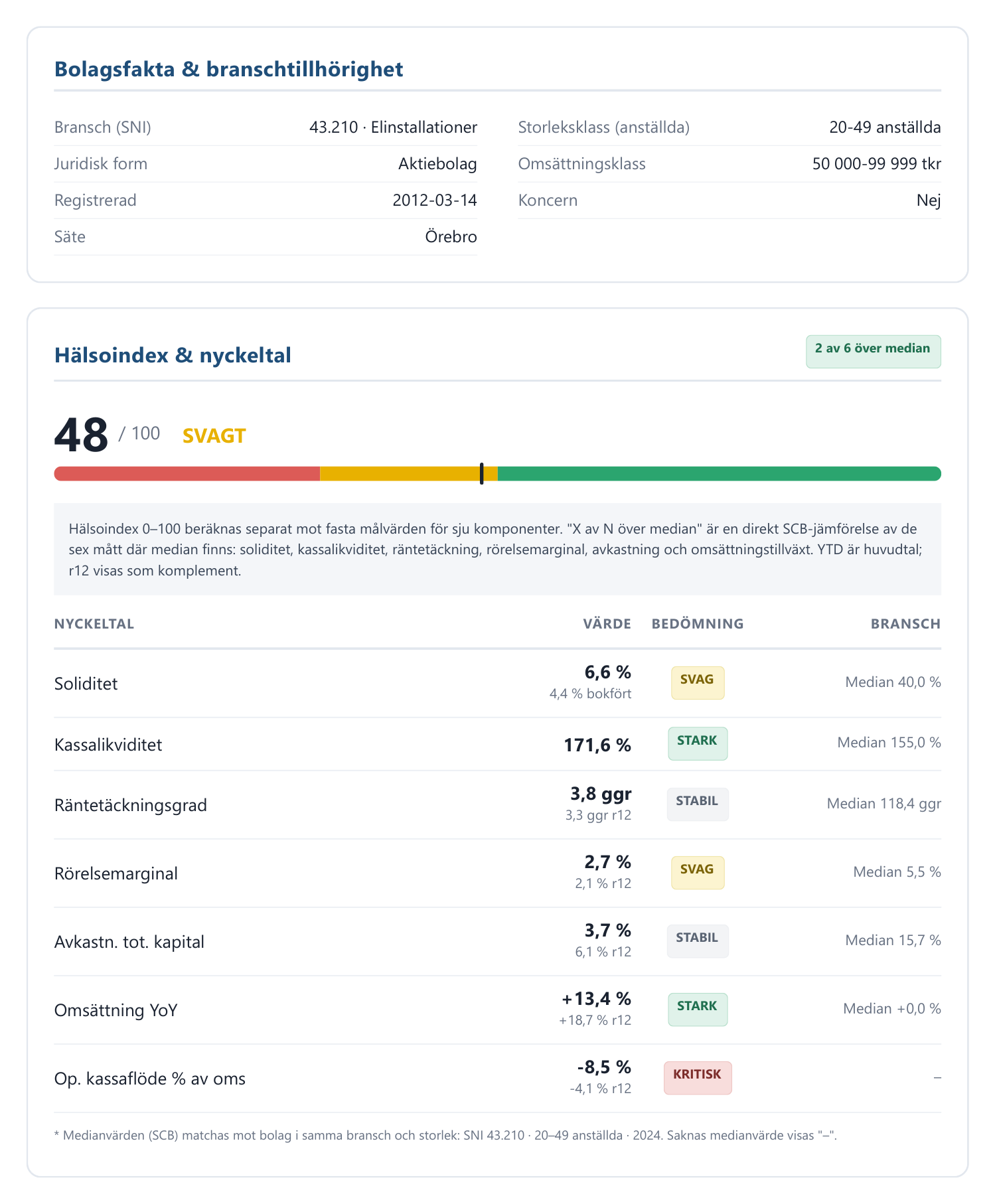
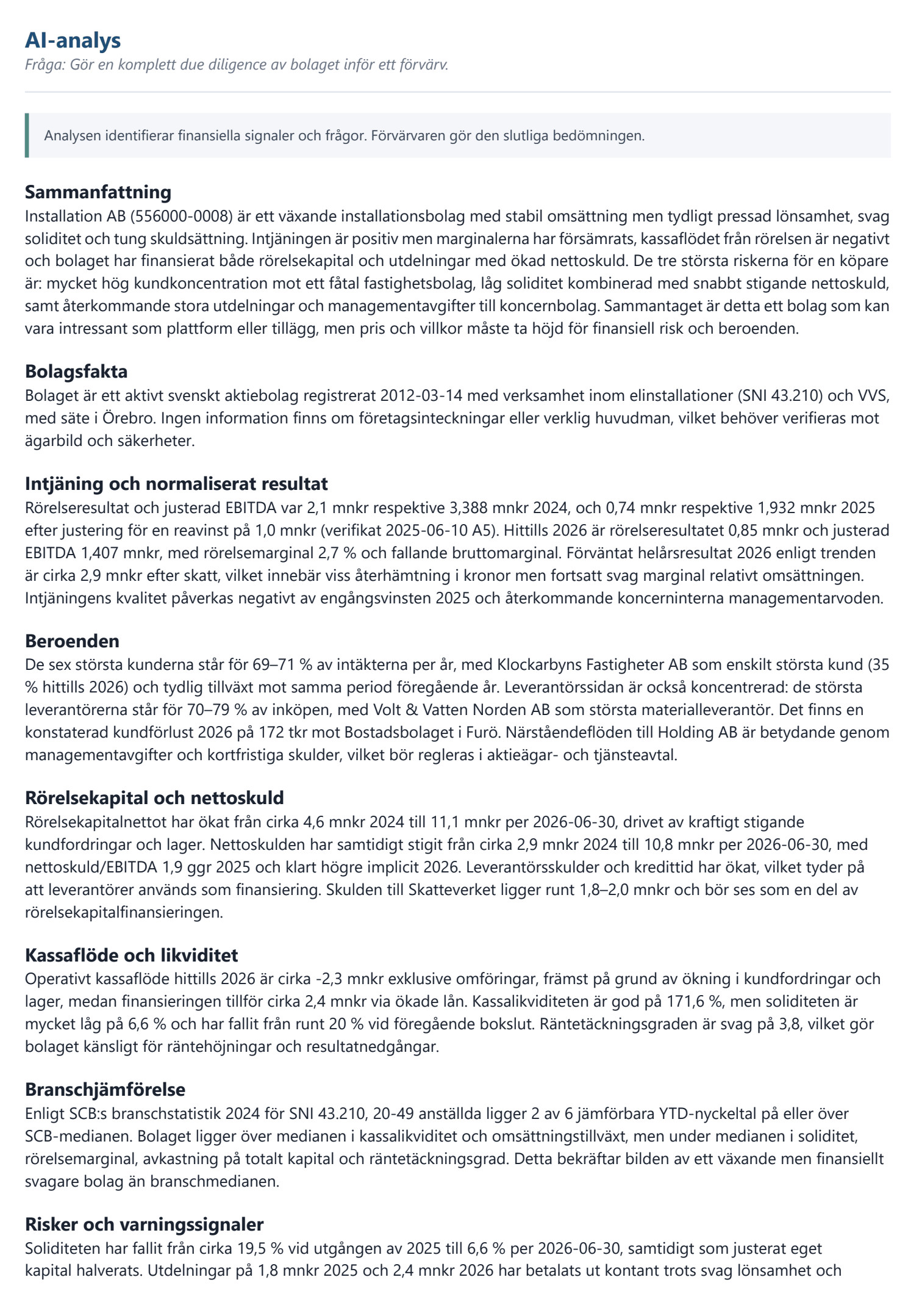
The whole report, eight pages with a method appendix: download the example report for Installation AB (PDF, in Swedish), created directly from the tool with the customer's own logo.
Free text against the books
Four questions ready. You write the rest yourself.
The standard questions are ready in the AI adviser when the target company is opened. You write follow-up questions the way you would say them, and the answers come with year, amount and journal entry.
The mode's standard questions
"Do a complete due diligence of the company ahead of an acquisition."
"Which customers and suppliers is the company most dependent on?"
"Which one-off items or individual deals make the earnings better or worse than they are?"
"What do net debt and working capital look like at each year end, and what has changed them?"
Examples of follow-up questions
"Which customers have decreased or disappeared since last year?"
"Do the dividends fit within the room for dividends?"
"Are there loans or payments to owners or related parties?"
"Show the largest journal entries over the last twelve months"
"How is revenue distributed across business units or projects?"
"What is driving operating cash flow this year?"
The material in
Request the files. No data room.
What drags out a due diligence is rarely the analysis. It is getting the accounting material out of a seller who emails a PDF of the annual report and thinks the matter is settled. In a process where exclusivity is measured in weeks, those are days lost in the wrong place.
You send a file request
Enter the email address of the seller's head of finance. The request says what is needed, SIE 4 with journal entries, and the upload page shows how to export the file from the most common accounting systems, one financial year at a time.
The counterparty uploads
The invitation goes to the same address, and if the address has no Microsoft account the recipient signs in with a one-time code. No password to create and no shared cloud folder. PDF, Excel and balance files are stopped before they are sent.
You decide when they are read in
A submitted file stays as submitted until you say so. Nothing is registered and no analysis starts until you have seen what actually came in.
Access ends when you say so
The counterparty sees a single box and never your analysis, your other cases or your company register. When the deal is done you remove the file provider, and the access is gone.
What to ask for, and why it should be one file per financial year, is covered in the guide to the SIE file in a due diligence (in Swedish).
For groups that grow through acquisitions
Due diligence on the next company, in the same tool that manages the existing ones.
Courtier Group is building a group of local estate agencies, where each agency keeps its name, its culture and its decisions. In Verksamhetskoll each agency sees its own results and the group sees the whole picture. When the next agency is to join, the due diligence is done in the same account: the target company's SIE files are uploaded, the report is ready in minutes, and the day the deal is done the company is added to the group with the same statement layouts as the others.
Due diligence is not included in any Planning package but is ordered as Company analysis, SEK 1,490 per month with three companies. For a group with Planning we add it to the same account.
Fresher than any register
The analysis reads the target company's current books at journal entry level, not last year's published accounts. You see how the company is doing now, up to the latest full month, in the middle of the process when it matters.
Discreet by design
The target company never has to connect any system or sign anything: the SIE files are enough, and storage and AI processing take place in Sweden. The PDF report, with your logo, is created directly in the browser.
Decision support in your due diligence. The figures are calculated from the books and are traceable down to the journal entry. Every answer is checked by a quality control before it is shown, including that the figures belong to the right period and the right counterparty. The investment decision and the responsibility are always yours.
The comparison run
Bring an acquisition you have already reviewed. Compare with the answer key.
A target company you have already been through is the most honest test: you know the answers and can see whether the tool finds them. Free of charge and without conditions.
Confidentiality first
We provide a confidentiality undertaking before any target company is uploaded, signed digitally with BankID (the Swedish e-ID).
You upload yourselves
You get a login and drag in the target company's SIE files, one per financial year. Nothing is emailed and nothing is sent to us.
A walkthrough within two working days
The analysis is ready in minutes. Within two working days we go through it together, about 45 minutes.
You compare with your review
Normalised earnings, net debt, working capital, dependencies and risks against what your own due diligence arrived at. The run is free of charge. Afterwards you keep the account or remove the company.
Price
Pay per user. Target companies as needed.
You pay for how many deals are running at the same time, not for how many you have looked at. When the review is done you remove the target company and the slot is free for the next.
Due Diligence
Three target companies are included, parent company and subsidiaries.
+ SEK 890 per month per additional user
Everyone on the account shares the same companies, with no double charging.
+ SEK 200 per month per extra target company
The slots are not locked to named target companies, switch in a few seconds.
Everything included
- The complete due diligence report or bankruptcy analysis from an SIE file in minutes, with no integration and no mapping
- Health index and key ratios against the Statistics Sweden (SCB) median for the same industry and size
- AI analysis grounded in the company's own figures, down to journal entry level
- Advanced report builder with drill-down and Excel export
- PDF reports with your own logo, created directly in the browser
- Several companies in one combined group view
- Storage and AI processing in Sweden (Microsoft Azure Sweden Central)
Terms
- When the case is finished, you remove the company and the slot is free for the next one
- Contributors who only submit files cost nothing
- The first run is free of charge, on a case where you already know the answer
- Volume pricing from six users
- No set-up fees
- All prices excl. VAT
Guides
The method behind the answers.
What a buyer looks for and where in the books it shows, with worked examples from the example report.
Frequently asked questions
Before you book.
- What do we need from the seller?
- The target company's SIE 4 files with journal entries, one file per financial year, preferably two full years and the current year. The file is exported from the accounting system in a few minutes, and the upload page shows how it is done in the most common systems. A balance file (SIE 1 to 3) is not enough for the analysis, and the tool says so at upload.
- What is left to verify in the acquisition?
- The analysis is based on the books. Legal, tax and commercial due diligence are not included, nor is valuation, contract review or market values of assets. The report therefore ends with what is left to verify in the acquisition, such as customer contracts, loan agreements and security, warranties, disputes, pensions and ownership. The acquirer makes the final assessment.
- How do you find the one-off items?
- Items booked as affecting comparability are recognised by the account: capital gains and losses, impairments, insurance compensation, grants and group contributions, per year and with journal entry numbers. The report calculates operating profit, EBITDA and adjusted EBITDA year by year. A large deal booked on an ordinary revenue account shows up instead as a customer that does not recur, and the standard question about individual deals is written to catch it. Owner salary and other remuneration are not recalculated to a market level; that assessment is yours.
- Can you do a due diligence on a whole group?
- Yes. Select the parent company and the subsidiaries, and the last three years are shown per company next to the group total: adjusted EBITDA, items affecting comparability, net debt or net cash and working capital. Growth is only calculated for companies that have a comparable period the year before, a shortened financial year is extrapolated to its real end, and client funds are reported separately.
- Does the target company have to connect any system?
- No. The seller exports the SIE files themselves and uploads them through your file request, or sends them to you. No integration, no access to the seller's systems and no mapping of the chart of accounts.
- We have Planning for the group. Can we do a due diligence in the same account?
- Yes. Due diligence is not included in any Planning package but is ordered as Company analysis, SEK 1,490 per month with three companies, and is added to the same account as the group. The target company's SIE files are uploaded where the group is already followed, and when the deal is done the company can be added to the group with the same statement layouts as the others.
- Where is the data handled?
- Storage and AI processing of accounting data take place in Sweden, in Microsoft Azure Sweden Central, and every customer has their own separated database. The PDF reports are created locally in the browser. The seller's head of finance sees only an upload box, never your analysis or your other companies.
- Who is behind Verksamhetskoll?
- Cenrotech AB, a Swedish product company with twenty years of experience in decision support. Verksamhetskoll is used by everyone from owner-managed companies to groups and municipally owned organisations, and all development, operation and support takes place in Sweden. The company presents itself at cenrotech.se.
- What does it cost?
- SEK 1,490 per month for the first user, and three target companies are included, parent company and subsidiaries. Each additional user costs SEK 890 per month, and target companies beyond the three SEK 200 per month per company. The slots are not locked to named companies: when the review is done you remove the target company and the slot is free for the next. File providers who only submit files cost nothing, and there are no set-up fees. All prices excl. VAT.
- How do we get started?
- Book a comparison run on an acquisition you have already reviewed: you upload the target company's SIE files yourselves after a signed confidentiality undertaking, we go through the analysis together within two working days and you compare with your own due diligence. That run is free of charge. If it holds up, you set up the account and bring in the next target company straight away, with no set-up fee.
Compare with your own due diligence.
Book a comparison run: you upload an acquisition you have already reviewed, we go through the analysis together within two working days, and you compare with your own review. It is the most honest test we can offer.
Two modes, the same engine and price
Wrong one? Switch track. The same analysis engine, before the deal and after the crash.
Both are modes in Verksamhetskoll Company analysis.